

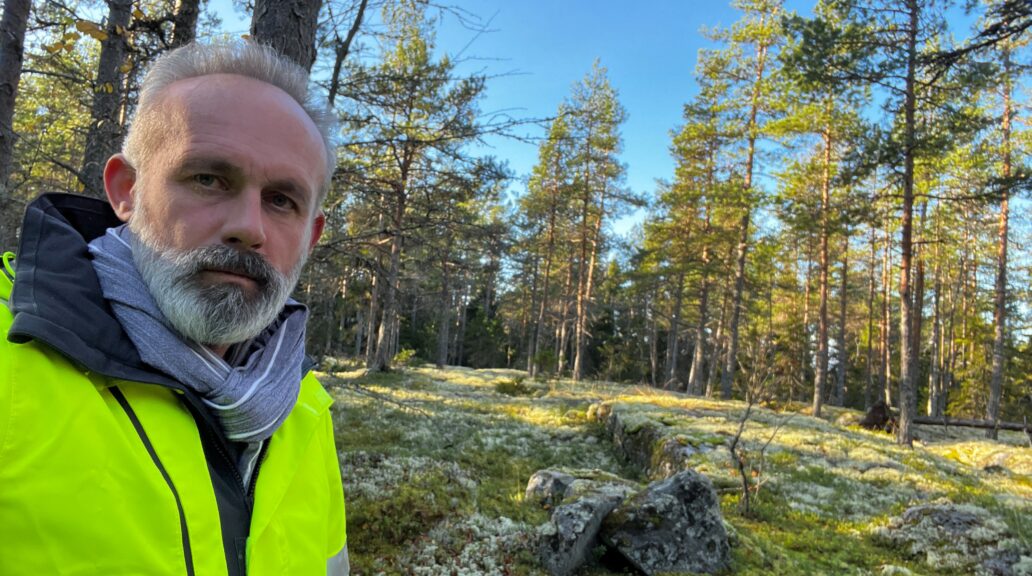
In the previous re:moss project, the Swedish company Boreal Orchards worked with the mining industry to restore ecosystems in mining-disturbed areas. Led by CEO and founder Daniel Pacurar, Boreal Orchards has already “mossified” several mining sites through re:moss. Using locally sourced native moss, the company developed a moss mixture (a moss primer) in the lab and applied it to sites to accelerate biocrust formation, the first layer of life on bare mineral surfaces.
The preliminary results have been promising, and the method has also been tested with the Swedish Transport Administration (Trafikverket) along the Norrbotniabanan railway project, while several ecosystem restoration projects are planned, including abroad.
Cladonia in focus
Now, to add a new piece to the biocrust reconstruction puzzle, the focus shifts to lichen, specifically to species within Cladonia genus, commonly known as reindeer lichens. They are a critical food source for reindeer. Unlike moss, lichens are symbionts – a partnership of different organisms – making off-site cultivation far more complex.
“We have a clear strategy to address this complexity, and a skilled researcher, Hasan Tükenmez on board, leading the lab work,” says Daniel Pacurar.
“We are confident in our ability to navigate the complex biology of lichens and develop a scalable solution for lichen restoration,” adds Hasan Tükenmez, CEO of Nordic BioConsult.
Involves eight partners
The project is carried out with financial support from the Impact Innovation program Swedish Metals & Minerals – an initiative of the Swedish Energy Agency, Formas and Vinnova – Sweden’s Innovation Agency.
The project involves eight partners: Boreal Orchards, Nordic BioConsult, Boliden, LKAB, Talga, Canadian mining company Teck Resources Limited, the Swedish Sámi National Association, and SLU. The involvement of the Sámi Association is crucial.
“Their engagement is key. They’ve been involved in the discussions from the beginning, and this is an important issue for them,” says Daniel.
“I also want to highlight that this initiative addresses two major challenges within the mining sector: it is expected to deliver a novel technical solution to the critical restoration of reindeer lichens, while supporting the future of the Sami way of life – an initiative that addresses ecosystem, industry, and societal needs – a symbiosis”.
Continued commitment from mining companies
Daniel Pacurar sees the continued commitment from Boliden, LKAB, and Talga as a strong sign that the industry truly believes in this new approach.
“The support the project received from our industry partners shows how important lichen restoration is, not only for their businesses, but also for the ecosystems and communities they depend on.”
Lichens need moss colonization to establish
There’s a simple logic to why symbios follows re:moss. Reindeer lichens can only gain a foothold once other early biocrust species — like crustose lichens and mosses — have already begun shaping the ground for them.
Simply put, preliminary moss colonization has been shown to be required for reindeer lichens to establish.
“symbios is the longest-running R&D project Boreal Orchards has undertaken so far, and the time is needed. If moss grows slowly, lichen grows even slower. We need time to optimize cultivation and scale up production.”
”When we pull this off, it will be a fantastic achievement”, concludes Daniel, who receives business support from Umeå Biotech Incubator (UBI) and is based at UBI’s facilities.
VOICES ABOUT THE PROJECT
Christin Jonasson, Environmental engineer, Talga:
“For Talga, long‑term responsible land use is a central part of our operations. The Symbiosis Project combines cutting‑edge research with practical application and addresses one of the more complex challenges in northern mining environments – the re‑establishment of reindeer lichen. Through the collaboration led by Boreal Orchards, we see strong potential to develop methods that both strengthen biodiversity and support long‑term sustainable coexistence between the mining industry and reindeer herding.”
Jenny Wik Karlsson, Operations Manager, Swedish Sami National Association: “Lichen is vital for reindeer survival during the long Arctic winters. To protect their grazing lands, large-scale restoration of lichen-rich habitats is essential, along with focused research on what drives lichen growth. Studies reveal that nearly 70% of lichen has disappeared from traditional herding areas, making sustainable solutions critical for the future of reindeer husbandry.”
Johanna Salatas, Reclamation Project Manager, Teck Resources Limited: “Teck is proud to partner with Boreal Orchards on innovative lichen restoration that advances science for the broader Arctic and supports sustainable closure at Red Dog Operations, honoring community desires to support Alaska’s caribou”.
Pia Lindström, Senior Vice President, Environment and Sustainability, LKAB: “LKAB works long‑term to restore natural environments and return our industrial areas to their original land use once mining operations cease. Because reindeer lichen establishes slowly in our climate, research is essential to optimise the process, and this project is helping to drive that work forward. We also see strong potential in gradually conducting both trials and full‑scale re‑establishment efforts at our mine sites while they are still in operation.”
Sara Carlsén, Biodiversity coordinator, Boliden: ”Boliden strives to restore nature and the original land use after our mines close, with a focus on biodiversity and reindeer grazing. With the technology developed with symbios we hope to secure an efficient and scalable solution to restore natural vegetation in arctic and boreal environments”.
ABOUT THE SYMBIOS PROJECT
Support: The work is carried out with financial support from the Impact Innovation program Swedish Metals & Minerals – an initiative of the Swedish Energy Agency, Formas and Vinnova-Sweden’s Innovation Agency.
Project owner: Boreal Orchards.
Project partners: Nordic BioConsult, Boliden, LKAB, Talga, Teck Resources Limited, Swedish Sámi National Association, SLU.
Financing: Vinnova 8,9 million SEK, other project partners 6,6 million SEK.
Project period: November 2025-October 2029.
For more info, please contact
Daniel Pacurar,
CEO & Founder, Boreal Orchards
Telephone: +46(0)761 27 62 49
Email: danielpacurar@borealorchards.se