

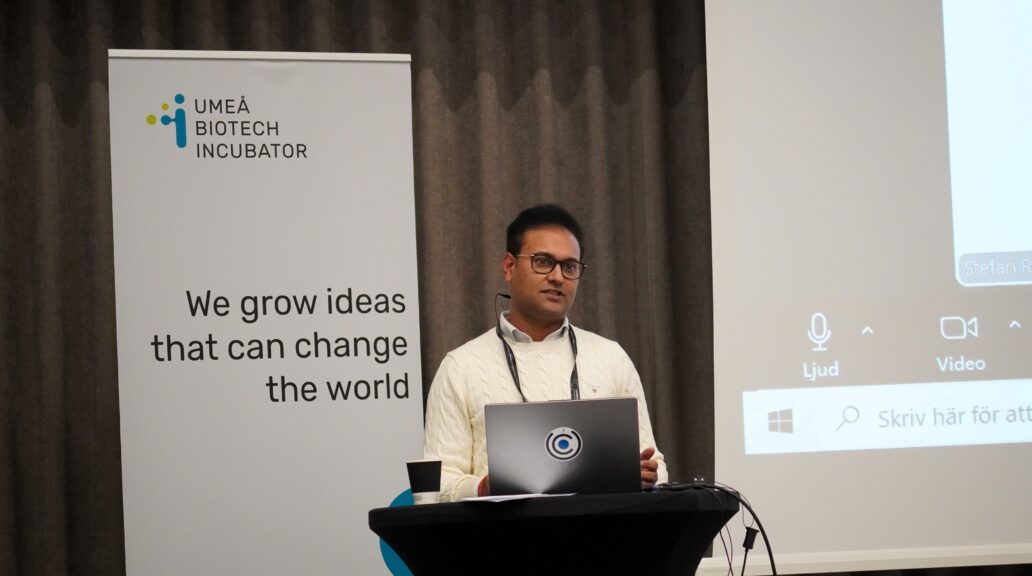
The third edition of the conference Open up for Innovation gathered researchers, industry representatives and doctoral students to explore how collaborations across sectors can accelerate scientific progress and generate value for society. The event, organised by Umeå Biotech Incubator (UBI), brought together around 70 researchers and 30 participants from industry, creating a dynamic arena for matchmaking, inspiration and exchange of experiences.
One of the invited speakers was Chinmay Dwibedi, whose research focuses on understanding human gut microbes at high resolution. His group investigates how bacterial strains evolve, differ functionally, and influence human health. The long-term aim is to pave the way for microbiome‑based therapies by identifying how specific microbes contribute to disease, health, and drug responses.
Eye-opening collaboration with BioGaia
Chinmay Dwibedi highlighted his collaboration with the probiotic company BioGaia AB, describing the partnership as both constructive and eye-opening.
“They are a science‑driven company with strong respect for evidence, and very open in sharing their knowledge on strains, manufacturing and efficacy. This real‑world perspective helps us put our academic findings into a more practical and translational context, he says.
Collaboration bridges discovery and application
Chinmay Dwibedi was recently awarded funding from the Industrial Doctoral School at Umeå University for a doctoral project in collaboration with BioGaia. He emphasised that academic–industry collaboration is essential for developing new probiotic concepts, including emerging ideas such as precision probiotics.
“It bridges discovery and application. What we see as exciting science may not always be feasible to translate into products because of cost, production or regulation. Industry brings valuable real‑world insight from clinicians and microbiologists, ensuring new concepts are both scientifically sound and practically relevant.”
Major potential in new therapies
Looking ahead, Chinmay Dwibedi sees major potential in personalised microbiome‑based therapies.
“These therapies are not one‑size‑fits‑all. A key opportunity is identifying which one benefits the most. With better clinical trials and integration of microbial, clinical and lifestyle data, we can move toward more targeted and effective interventions.”
He also noted the Open up for Innovation event for its inspiring atmosphere and ambitions.
“It was great to hear about the region’s strategic focus on investment and translational science. And it was clearly valuable for doctoral students exploring opportunities beyond academia.”
From the regional life science strategy to international insights
In total, the Open up for Innovation programme brought together speakers from academia, start‑ups, and established life science companies to highlight concrete examples of collaboration.
Göran Larsson (Region Västerbotten) and Mikael Elofsson (Umeå University) opened the day with presentations on the regional life science strategy and Umeå University’s Vision 2035, followed by local company perspectives and collaboration cases presented by Chinmay Dwibedi, Linda Sandblad (SciLifeLab), UiT The Arctic University of Norway and ArcticZymes Technologies.
Ida Lautenbach, senior strategic adviser, shared national and international insights from the Olink journey, before keynote speaker Rita Balice-Gordon (CEO, Muna Therapeutics) reflected on working across academia, biotech and pharma, concluding with a panel discussion on strengthening academia–industry partnerships.
WRITER: Ingrid Söderbergh/UCMR, Umeå university